
Building new infrastructure takes more than capital, equipment and technology. It takes people who are prepared to build, operate and maintain it, along with a sustained commitment to helping those people succeed.
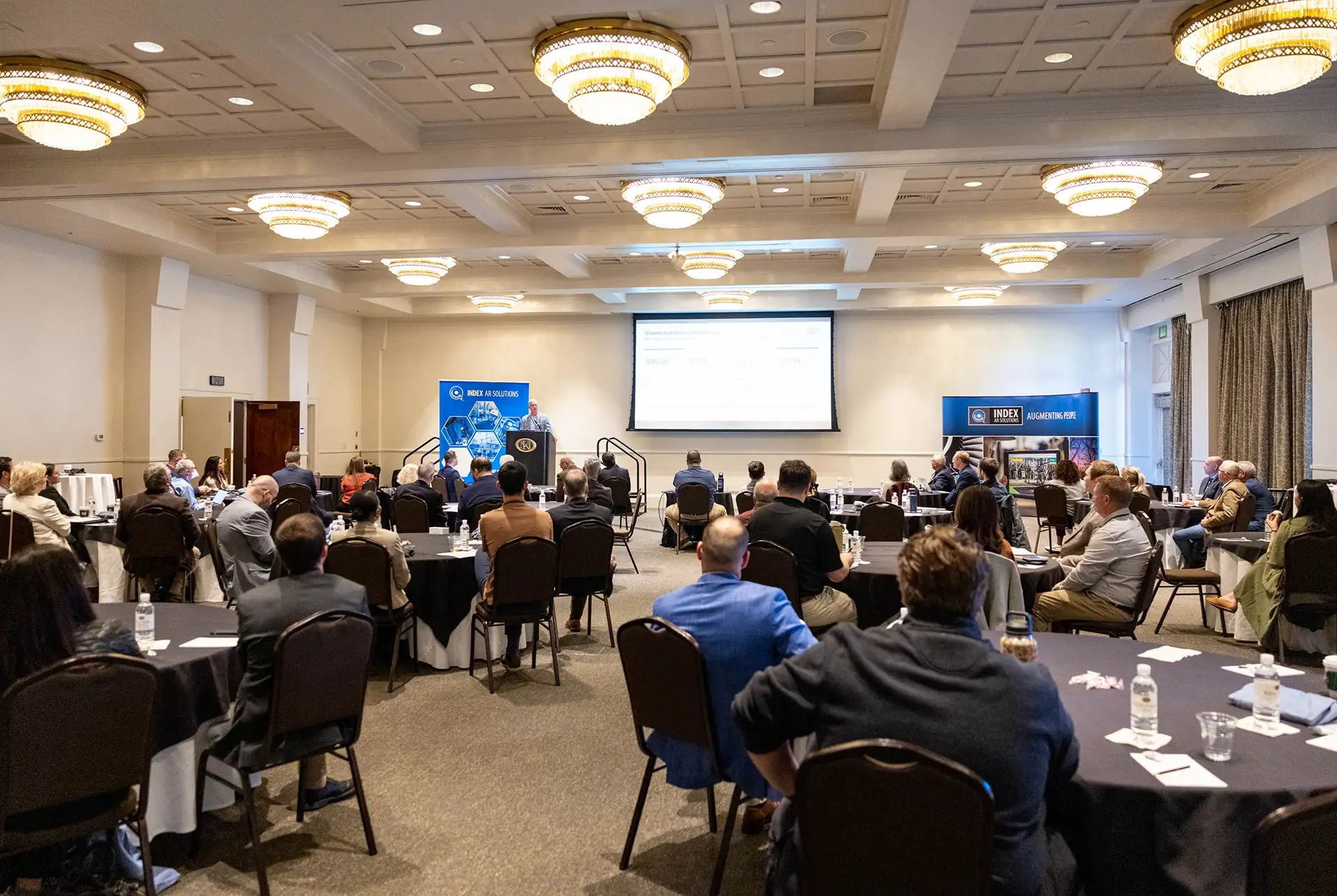
That message connected conversations across the Index AR Solutions 2026 Fall Conference, held October 26–27 at Kingsmill Resort in Williamsburg, Virginia. Centered on “Accelerating Workforce Development,” the gathering brought together leaders from utilities, industry, healthcare and higher education to share challenges, demonstrate progress and explore new approaches to learning.
From digital apprenticeship curricula and wildfire mitigation training to interactive biology applications and clinical education, presenters showed how putting trusted information in people’s hands can help close the gap between instruction and application.
“The demand for skilled workers is growing across the industries we serve, and preparing people for that work requires a sustained investment in how they learn,” said Dan Arczynski, CEO of Index AR Solutions, who kicked off the conference. “Bringing our clients and partners together gives us the opportunity to learn from one another and find practical ways to help people work more safely, confidently and productively.”
Making Workforce Readiness a Business Priority
Phil Ulrich, Executive Vice President and Chief Human Resources Officer at American Electric Power, framed workforce development as an executive responsibility with direct consequences for business performance.
As utilities respond to rising demand from data centers, advanced manufacturing and electrification, their ability to execute depends on having enough skilled people and developing their capabilities quickly enough to keep pace.
“Capital plans are only as good as our ability to execute,” Ulrich said.
He described AEP’s efforts to strengthen recruiting, build early career pipelines and bring learning closer to the work itself. Digital books, mobile applications and standardized visual guidance developed with Index are part of that approach, helping employees access consistent information while preserving experienced workers’ knowledge.
Anthony W. Gagliardo, Ed.D., Principal Director at Accenture, extended the discussion beyond individual employers. Competing for the same limited pool of workers cannot, by itself, create the capacity industries need. He called for collaboration, more individualized learning paths and greater recognition of skills that transfer across organizations and sectors.
Barry DuVal, President and CEO of ITA Growth Partners and former President and CEO of the Virginia Chamber of Commerce, connected those priorities to economic prosperity. Drawing on his experience in regional and state leadership, he highlighted the relationship among connectivity, intellectual capacity, a competent workforce, energy and policies that support business growth.
Together, their presentations emphasized that workforce readiness belongs in long-term planning and investment decisions.
Bringing Learning Closer to the Work
Utility leaders offered practical examples of what that investment looks like.
Carrie Laird, Vice President of Wildfire Mitigation and Emergency Operations at PacifiCorp, described the profound changes wildfire risk has brought to frontline operations. Employees must navigate new technology, evolving procedures and difficult decisions about restoring service safely.
Working with Index, PacifiCorp developed mobile applications that explain the reasoning behind wildfire mitigation practices and help employees prepare for field conditions. An outage scenario application uses challenging restoration situations to help workers practice troubleshooting and decision-making. Frontline employee involvement helped shape tools grounded in the work they actually perform.
At ComEd, Betsy Bailey, Vice President of Human Resources, described a broader effort to rethink how the utility attracts, hires, develops and retains skilled workers. Through its Digital Worker Initiative, ComEd is partnering with Index to replace paper-heavy materials with a digital curriculum that includes Index interactive applications.
The first class using the overhead helper curriculum developed in partnership with Index offered an encouraging response: students wanted to keep the pilot iPads. Bailey pointed to knot-tying videos as a simple example of how learners can revisit a demonstration and practice beyond the classroom.
Doug Barber, who oversees nuclear maintenance and technical and energy supply training at Xcel Energy, emphasized the employee experience. He described early instructor feedback from a power plant operator training pilot: after two weeks with the materials, new learners were asking questions instructors would typically expect much later in the program.
Barber also discussed Xcel’s plans to expand its work with Index into distribution training. A consistent digital foundation, he explained, can support instructors, apprentices and leaders while making it easier to introduce training as equipment and technology change.
Connecting Technology With Human Performance
James Merlo, Ph.D., CEO of the North American Generator Forum, connected the urgency of expanding electric generation with the human performance challenges of preparing the workforce.
His discussion of memory, attention and mental models underscored the value of combining visual explanations, practice and accessible references. Helping someone understand how a system works—and retrieve that knowledge when needed—is central to effective training.
Jack Cronin, Managing Director of Acumen Aerospace & Defense Advisers, brought a shipbuilding perspective through the Factory 4.0 study. He described a vision for connected manufacturing in which workers receive guidance, information and quality feedback at the point of work. Achieving that vision requires deliberate job design, frontline involvement and training that helps employees understand the wider production system.
Brigadier General James Golden, Ph.D., U.S. Army (Ret.), Senior Counselor to the President at William & Mary, encouraged attendees to recognize opportunities created by change. Drawing on soccer and his book, Seeing the Spaces, he described how coordinated movement creates opportunities for an entire team—a useful perspective for organizations rethinking jobs, technology and learning together.
Exploring Trusted AI for Skilled Workers
Doug Schmidt, Ph.D., Dean of William & Mary’s School of Computing, Data Sciences & Physics, explored how artificial intelligence could support skilled workers in fields where errors carry serious consequences.
His emphasis was on trusted, carefully constrained tools grounded in vetted information, with people retaining decision authority. He identified Index’s library of content developed with experienced subject matter experts as a valuable foundation for exploring that potential.
Schmidt recommended beginning with a narrow set of valuable tasks, validating results with experts and expanding deliberately. His presentation outlined an opportunity for future development, with accuracy, context and safeguards guiding the work.
Extending the Conversation Into Healthcare and Higher Education
Two panels showed how similar learning challenges appear in very different settings.
Moderated by Index’s Zach Korkowski, the Riverside Health panel featured emergency physicians John Alex, M.D., and Nathaniel Minnick, D.O. They discussed their collaboration with Index on a central venous access device training package that combines reference information with procedural guidance.
Developing the package brought specialists together around a standardized approach reflecting Riverside’s equipment, practices and clinical expertise. The physicians also explored possibilities for future patient education tools, including resources people could revisit before and after procedures.
Index’s Cam Fleming moderated a panel with William & Mary’s Paul Heideman, Ph.D., Margaret Saha, Ph.D., and Patricia Habersham, Ph.D. The professors discussed helping students move beyond recalling facts to applying knowledge, solving problems and identifying gaps in their understanding.
Habersham described improvements to the biology applications used by her students based on classroom feedback, including step-by-step explanations, videos, interactive practice and questions that check understanding. Students can manipulate elements of a biological process, see where they become stuck and ask more focused questions. Instructors can teach directly from the applications and guide that practice in real time.
Building Progress Through Partnership
Andy Ralph, Vice President of Project Development at TransGrid Energy and Index’s first client from 2015, reflected on the company’s evolution from early augmented reality demonstrations to the range of workforce and education applications shared at the conference.
Across the presentations, a consistent ingredient was partnership: experienced professionals working alongside Index teams to turn their knowledge into practical learning tools, then refining those tools through feedback.
In his closing remarks, Index’s John Arczynski returned to that shared effort.
“We can only make what we do by building it together with you,” he said.
Thank you to the presenters, panelists, clients and colleagues who contributed their experience and ideas to the 2026 Fall Conference. Those conversations will continue to inform Index’s work as the company helps organizations prepare people for the challenges ahead.